
Why Is Water Irreplaceable?
Water is the source of life – a phrase we’ve heard countless times, something we all learned as children, yet few truly reflect on its meaning. Beyond its evolutionary significance, water plays a central role throughout the entire life cycle of all living beings. Despite the fact that 70% of the Earth’s surface is covered by water, less than 1% of all water on the planet is available as drinking water.
While on one hand, melting glaciers are causing sea levels – that is, saltwater – to rise, on the other hand, clean, unpolluted freshwater is becoming increasingly scarce. We often take it for granted – until it stops flowing from the tap.
Some experts predicted years ago that major conflicts over water lie ahead!
What has led to this situation?
Climate Change and Water
Climate change not only reduces the availability of water through droughts and glacier melt but also causes floods that destroy sources of drinking water. Extreme weather conditions are becoming the new norm, making water resource planning and management increasingly difficult.
Hidden Water: How Much Do We Really Use?
How many liters of water do you need per day? More than you think! On average, each person consumes about 200 liters of water daily. And we’re not just talking about showering or washing dishes. For example, producing a single cup of coffee requires around 140 liters of water, while one pair of jeans „uses up“ approximately 10,000 liters – this is the concept of virtual water. Our consumer choices have a direct impact on global water consumption.
Pollution: An Enemy That Targets Everything
Industrial waste, pesticides, microplastics, untreated sewage – all of it ends up in rivers, lakes, and groundwater. In Serbia, one of the biggest issues is the lack of proper sewage systems and pollution caused by mining, especially in areas with intensive extraction of ores and metals. The result? Water that smells, foams, or even worse – looks completely normal, but is actually hazardous to human health.
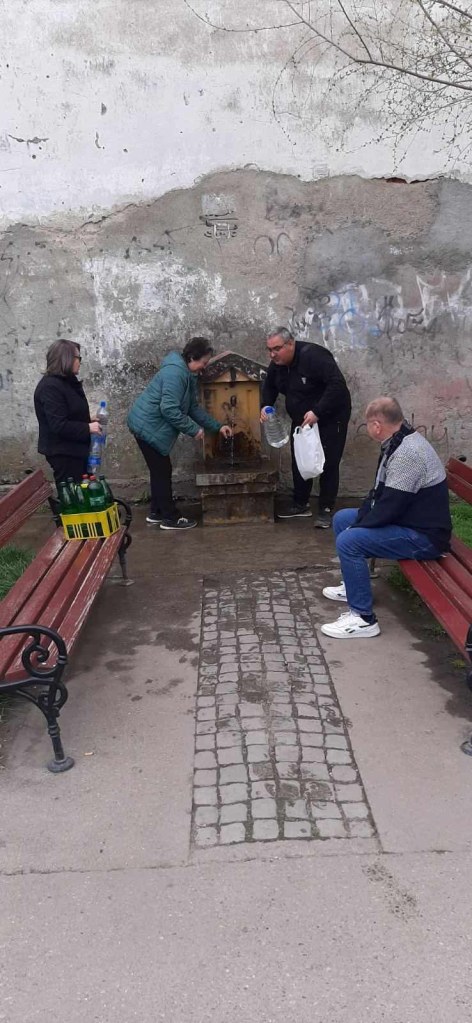
In the municipality of Negotin, in many villages such as Radujevac, Prahovo, and others, almost every household has a well—but the water in them is chemically unsafe. People are forced to carry water from public fountains in town, filling up plastic bottles and jugs, and drinking from them for a week or even two until their next trip to the city. A similar problem affects another 2 billion people around the world.
Water: A Right or a Privilege?
This raises the question – is water a basic human right or a commodity to be sold to those who can afford it? Access to drinking water for every person on Earth should be taken for granted, but what is the actual reality? The sale of springs to large corporations and the privatization of water supply systems in some countries have led to higher prices and reduced access for poorer communities. When water is treated as a product, humanity disappears from the equation.
Who Protects the Right to Water?
The UN declared access to safe drinking water and sanitation a fundamental human right in 2010. International organizations such as WHO, UNICEF, and Water.org are actively working to improve water supply systems, especially in poor and rural areas. However, without public pressure and political will, their power remains limited.
Air pollution has already become a harsh reality, the soil is increasingly contaminated by the use of various chemicals in agriculture, and healthy food is becoming scarcer — will we at least manage to preserve water? Will we learn anything from the past years?
What Awaits Us If Nothing Changes?
Twenty years ago, very few buildings had air conditioning, warnings about the effects of global warming were largely ignored, and no one believed that within just two decades the heat would become unbearable and air conditioners would become a must-have.
Some companies have already brought solutions for the drinking water problem to the market. They offer various water purification devices and filters. Just like with air conditioners, the demand for such products will only increase. Free, clean drinking water will become increasingly rare, and we will be left to face challenges such as:
Will we pay more for a bottle of clean water than for a liter of fuel?
Will water become a luxury?
And most importantly — how long will we keep pretending we don’t see the problem?
What Can We Do?
You don’t have to be a scientist or an activist to help. Here are a few practical tips:
- Turn off the tap while brushing your teeth or soaping your hands.
- Fix leaking faucets – drip by drip, liters are lost.
- Collect rainwater for watering plants.
- Use water-saving devices (e.g., efficient showerheads).
- Buy local and consume less – less production = less water use.
- Educate yourself and others about virtual water and sustainable habits.
Conclusion: It’s Time to Defend Every Drop
Water is not just a resource – it is a right, a need, and the foundation of our future. As the world faces a water crisis, every individual can be part of the solution. Knowledge, responsibility, and solidarity are our strongest tools.
A single drop may seem insignificant. It’s easy to ignore. But drop by drop, an ocean is formed – powerful, persistent, and unstoppable. In the same way, our small, everyday decisions can create a wave of change that brings clean water to all.
change projects
20,00 $
 new way
Postavi komentar